4 Person Yoga Poses: Best Acro Yoga Poses for Groups
by Susan T.
Last summer, four of us crammed onto two yoga mats in my backyard, tried stacking into a pose we saw online, and immediately collapsed into a pile of laughter. That chaotic attempt turned into a weekly tradition — and eventually, we figured out how to actually hold the poses. If you've been curious about 4 person yoga poses, you're in for something that blends trust, strength, and genuine fun in a way solo practice never can. Whether you're exploring new yoga poses or leveling up from partner work, group acro yoga delivers a unique challenge worth pursuing.
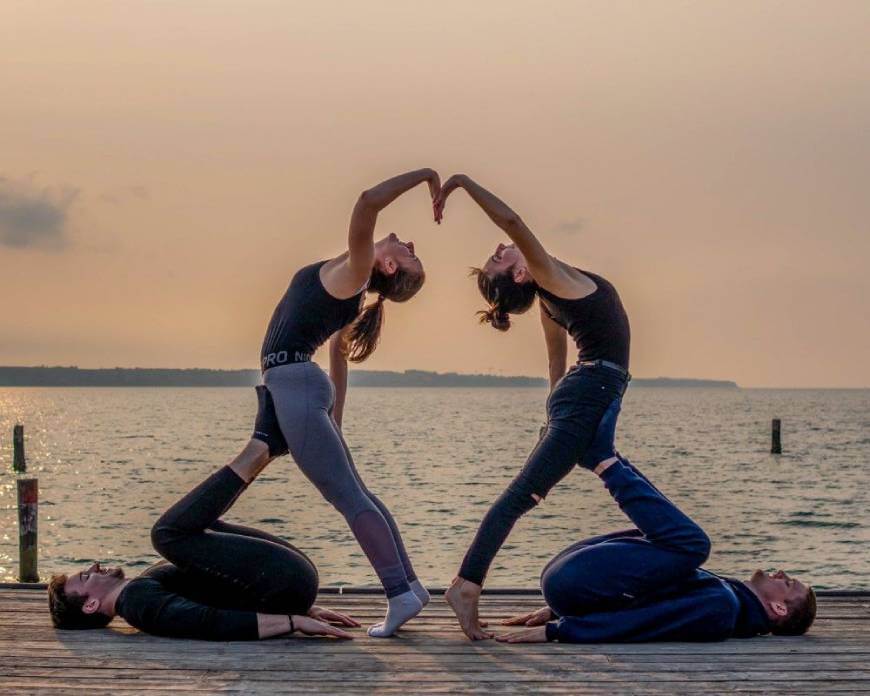
Group yoga isn't just a social media trend. It's a legitimate practice rooted in acroyoga traditions that combine acrobatics, yoga, and therapeutic techniques. When you bring four people together, you multiply the possibilities — and the benefits. You build communication skills, deepen trust, and push your physical limits in ways that a solo sun salutation simply can't match.
This guide walks you through the best 4 person yoga poses, what gear you need, how to troubleshoot common problems, and how to build a sustainable group practice. If you've already experimented with 2-person yoga poses, you're ready to expand your circle.
Contents
What Makes Group Acro Yoga Different
Solo yoga develops your personal practice. Partner yoga introduces connection. But 4 person yoga poses take things to an entirely different level. You're not just balancing against one other body — you're coordinating four nervous systems, four sets of muscles, and four different flexibility levels into a single cohesive structure.
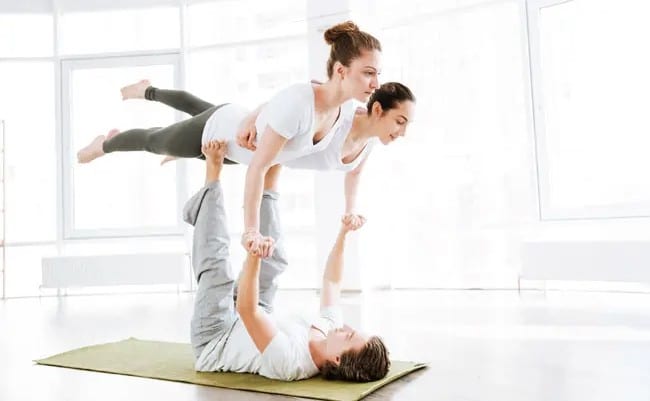
Roles in a 4 Person Formation
Every group formation assigns specific roles. Understanding these roles before you start prevents confusion and injury:
- Base(s) — the person or people on the ground bearing the most weight. Bases need strong legs, a stable core, and the patience to hold still while others climb.
- Flyers — the ones lifted off the ground. Flyers should be lighter relative to the bases but also need solid core engagement and body awareness.
- Spotters — in a four-person group, you often have someone acting as a spotter until everyone is in position. Safety is non-negotiable.
- Connectors — people linking two sub-formations together, such as holding hands between two stacked pairs.
In most 4 person poses, two people serve as bases and two as flyers, though some formations use a single base with three connected partners.
The Trust Factor
You can't fake trust in a group formation. If one person hesitates mid-pose, everyone feels it. That's what makes this practice so powerful — it forces genuine vulnerability and communication. Before attempting any advanced 4 person yoga poses, spend time doing warm-up exercises together and practicing basic partner balances.
The payoff is worth the investment. Groups that practice together regularly report stronger interpersonal bonds and a deeper sense of accountability in their fitness routines. If you're wondering how often you should practice yoga, aim for at least one group session per week alongside your solo practice.
Best 4 Person Yoga Poses to Try
These poses range from beginner-friendly to advanced. Start at the top and work your way down as your group builds confidence and strength.
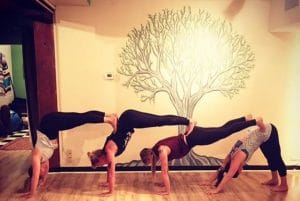
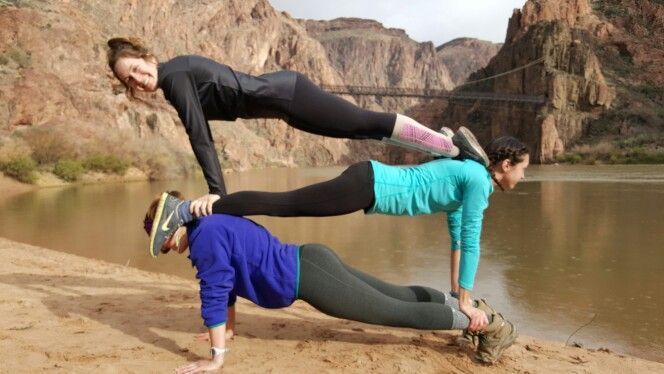
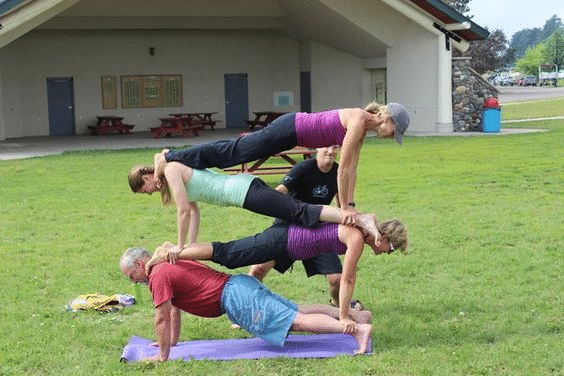
Four-Way Plank Stack
This is the go-to starter pose for groups. It looks impressive but is surprisingly accessible.
- Person 1 holds a standard plank on the ground.
- Person 2 places their hands on Person 1's ankles and feet on the floor behind, forming a plank at an angle.
- Person 3 places their hands on Person 2's ankles, extending the chain.
- Person 4 completes the formation by connecting to Person 3.
Key tip: the first person in the chain bears the most load. Put your strongest member on the ground. Everyone else should engage their core and keep hips level — no sagging or piking.
Group Boat Pose
All four partners sit in a circle facing each other, legs extended toward the center.
- Each person grabs the ankles or feet of the person across from them.
- Simultaneously, everyone lifts their legs into a V-shape, leaning back slightly.
- Hold for 5–10 breaths.
This one torches your core. If your group is still working on flexibility, bend the knees slightly rather than forcing straight legs.
Diamond Warrior Formation
Four people stand in a diamond pattern, each facing outward. Everyone drops into Warrior II simultaneously, reaching toward the person on either side to connect hands. The result is a symmetrical diamond of warriors linked by their outstretched arms.
This pose builds leg endurance and demands synchronized timing. Count into the pose together — "three, two, one, drop" — so everyone lands at the same depth.
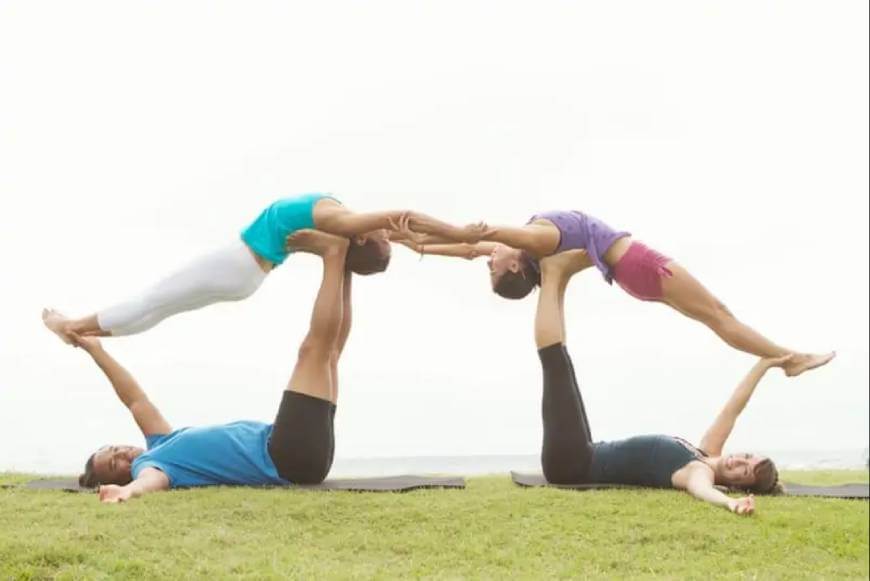
Stacked Supported Bridge
Two people lie on their backs in bridge pose, side by side. The other two carefully position themselves on top, using the first pair's hips and shoulders as support for their own bridge.
- Bottom pair: keep feet hip-width apart, press firmly through your heels.
- Top pair: place hands on the bottom pair's shoulders for stability before lifting.
- Hold for 3–5 breaths, then exit by having the top pair lower first.

Always designate one person as the verbal leader who calls "enter" and "exit" for every pose. Unclear transitions cause most group yoga injuries.
Essential Gear for Group Yoga Sessions
You don't need much, but the right equipment makes a significant difference in safety and comfort when practicing 4 person yoga poses.
Mats and Surfaces
Standard yoga mats work for individual positions, but for group formations you need more surface area. Consider these options:
- Oversized yoga mats (6' x 8' or larger) — eliminate the gaps between individual mats where feet can slip.
- Thick exercise mats — provide extra cushion for bases lying on their backs. Check out the differences between an exercise mat and standard yoga mat to find what works best.
- Grass or sand — outdoor surfaces work well for group practice, especially when you're still learning and falls are likely.
What to Wear
Baggy clothing catches on limbs and obscures body alignment. Stick to fitted, moisture-wicking gear:
- Compression shorts or fitted yoga shorts for bases who need full range of motion.
- High-waisted leggings that stay put — nothing kills a pose faster than adjusting your waistband mid-hold.
- Tops that won't ride up when you're inverted.
- Bare feet always. Socks are a slip hazard on skin.
Common Mistakes and How to Fix Them
Even experienced yogis stumble when they transition from solo or partner practice to four-person formations. Here are the issues that come up most often — and how to solve them quickly.
Communication Breakdowns
- Problem: everyone talks at once, no one listens.
- Fix: assign one leader per pose. Rotate leadership each round so everyone gets practice directing.
- Problem: someone is in pain but stays silent to avoid "ruining" the pose.
- Fix: establish a universal safe word before starting. "Down" means everyone exits immediately, no questions asked.
Alignment Errors
- Problem: bases collapsing because flyers are positioned too far forward or back.
- Fix: flyers should stack their weight directly over the base's bones (hips over hips, shoulders over shoulders). Muscle holds for seconds — skeletal stacking holds for minutes.
- Problem: shaking and wobbling within the first few seconds.
- Fix: this usually signals that someone skipped the warm-up. Spend at least 10 minutes on joint circles, sun salutations, and individual balance work before attempting group poses. A good slow flow yoga sequence is perfect for this.
If a pose feels wrong in your joints — not just your muscles — exit immediately. Joint pain is your body's non-negotiable stop signal.
Benefits and Challenges of 4 Person Yoga Poses
Before committing your group to regular practice, you should understand what you're signing up for. Here's an honest breakdown:
| Benefits | Challenges |
|---|---|
| Builds deep trust and communication skills | Requires coordinating 4 schedules |
| Develops strength you can't build solo — especially core and stabilizers | Skill gaps between members can limit pose selection |
| Creates accountability and consistency in your practice | Higher injury risk without proper spotting |
| More fun and motivating than solo sessions | Needs more space and equipment than individual yoga |
| Teaches body awareness and spatial coordination | Progress can feel slow when the whole group must advance together |
| Builds muscle through isometric holds and partner resistance | Ego conflicts — someone always wants to try poses the group isn't ready for |
The benefits outweigh the challenges for most groups, but only if you approach it with patience. If you're curious about the strength-building side, yoga absolutely builds muscle — and group formations amplify the effect because you're supporting external weight beyond your own body.
Building a Consistent Group Yoga Routine
The hardest part of 4 person yoga isn't the poses — it's getting four people in the same place at the same time, consistently. Here's how to make it stick.
Scheduling and Commitment
- Lock in a recurring time. Sunday mornings, Wednesday evenings — whatever works. Treat it like a class you've paid for.
- Set a minimum commitment. Agree to 8 sessions before anyone decides whether to continue. One session isn't enough to judge.
- Have a backup plan. If one person can't make it, practice 3-person variations or work on partner poses instead of canceling entirely.
- Rotate the host. Sharing the responsibility of setting up space keeps everyone invested.
Progression Path
Structure your group's progression over time to avoid plateaus and keep everyone engaged:
- Weeks 1–4: Master basic standing formations (Diamond Warrior, Group Tree Pose, Circle Forward Fold). Focus on communication protocols and synchronized breathing.
- Weeks 5–8: Introduce ground-based formations (Group Boat, Plank Stacks). Start practicing entries and exits with verbal cues.
- Weeks 9–12: Attempt flying poses (Stacked Bridge, Double Front Plank with spotters). Incorporate hold times of 5+ breaths.
- Ongoing: Create your own formations, document them with photos, and refine your group's signature poses.
Best Scenarios for Group Yoga Formations
Not every yoga session calls for a four-person formation. Knowing when to use these poses — and when to stick to solo practice — helps you get the most from both.
Events and Retreats
4 person yoga poses are perfect for:
- Yoga retreats — group formations are natural icebreakers and build community fast.
- Team-building events — corporate groups use acro yoga to develop trust and communication outside the office.
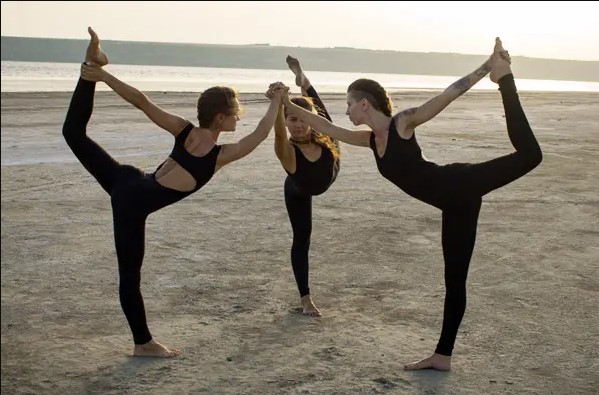
- Social gatherings — yoga brunches, beach meetups, or park sessions where the focus is connection over intensity.
- Content creation — group poses photograph and film exceptionally well. They're inherently eye-catching.
Specific Fitness Goals
Choose group yoga when your goals align with what it offers best:
- Core strength — nearly every 4 person pose demands sustained core engagement from all participants.
- Balance and proprioception — supporting and being supported by others trains your stabilizer muscles in ways unilateral exercises can't.
- Upper body endurance — base roles require extended holds in push-up and press positions.
- Mental resilience — staying calm while another human stands on your hips builds focus under pressure.
Stick with solo practice when you need deep stretching, meditative focus, or when you're recovering from injury and can't safely bear external weight.
Frequently Asked Questions
Do all four people need to be the same skill level?
No. Mixed skill levels work fine as long as you assign roles appropriately. Put experienced practitioners in base positions and newer yogis in supported roles. The key is honest communication about each person's limits — never pressure a beginner into a role they're not ready for.
What's the ideal body weight distribution for a group of four?
Bases should generally be heavier and stronger than flyers, but there's no strict formula. A 180-pound base can comfortably support a 130-pound flyer in most formations. Focus on strength-to-weight ratio rather than absolute numbers. The strongest people go on the bottom regardless of gender.
How long should you hold a 4 person yoga pose?
Start with 3–5 breaths (roughly 15–30 seconds) and build from there. Advanced groups hold poses for 30–60 seconds. If anyone shakes uncontrollably or reports pain, exit immediately. Endurance develops over weeks, not within a single session.
Can kids participate in 4 person yoga poses?
Children aged 8 and older can participate in ground-based formations like Group Boat or standing formations like Diamond Warrior. Avoid any flying or stacking poses with children unless supervised by a certified acro yoga instructor. Keep it playful and never force a child into a pose they're uncomfortable with.
What should you do if someone gets hurt during a group pose?
Stop immediately — all four people exit the pose. Assess the injury before continuing. For minor strains, ice and rest. For sharp joint pain, numbness, or anything involving the neck or spine, seek medical attention. Prevention is better: warm up thoroughly, use a spotter, and never attempt a pose your group hasn't practiced the individual components of.
Is 4 person yoga good for weight loss?
Group yoga burns more calories than restorative or gentle yoga because the holds are isometrically demanding and many transitions raise your heart rate. However, it's better categorized as a strength and coordination practice than a cardio workout. Pair it with active flow sessions for a well-rounded fitness approach.
How much space do you need for 4 person yoga?
Plan for a minimum of 10 feet by 10 feet of clear space. Outdoor surfaces like flat grass or packed sand work best when you're learning. Remove any furniture, sharp objects, or hard surfaces from the fall zone. If practicing indoors, a room with high ceilings is essential for any poses involving standing on another person.
Four people, one pose, zero room for ego — that's where the real yoga happens.


About Susan T.
Susan T. is an internationally recognized yoga teacher who has spent years leading teacher trainings, workshops, and retreats around the world. Her work has been featured in Yoga Journal, Mantra Yoga, and the San Jose Mercury News, and she brings the same accessible, grounded approach to her writing that she brings to the mat — focused on what yoga actually does for real bodies and real lives rather than what it looks like in a photoshoot. At the site, she covers yoga tips and technique guides, gear and accessory reviews, and resources for practitioners at every stage of their practice.